Strategies for High-Spending OnlyFans Subscribers (Our Whale Playbook)
Author
Lukas Böse · Founder of Boese VA
Lukas runs Boese VA’s 24/7 chatting team and helps creators and agencies grow on OnlyFans. Lukas on YouTube
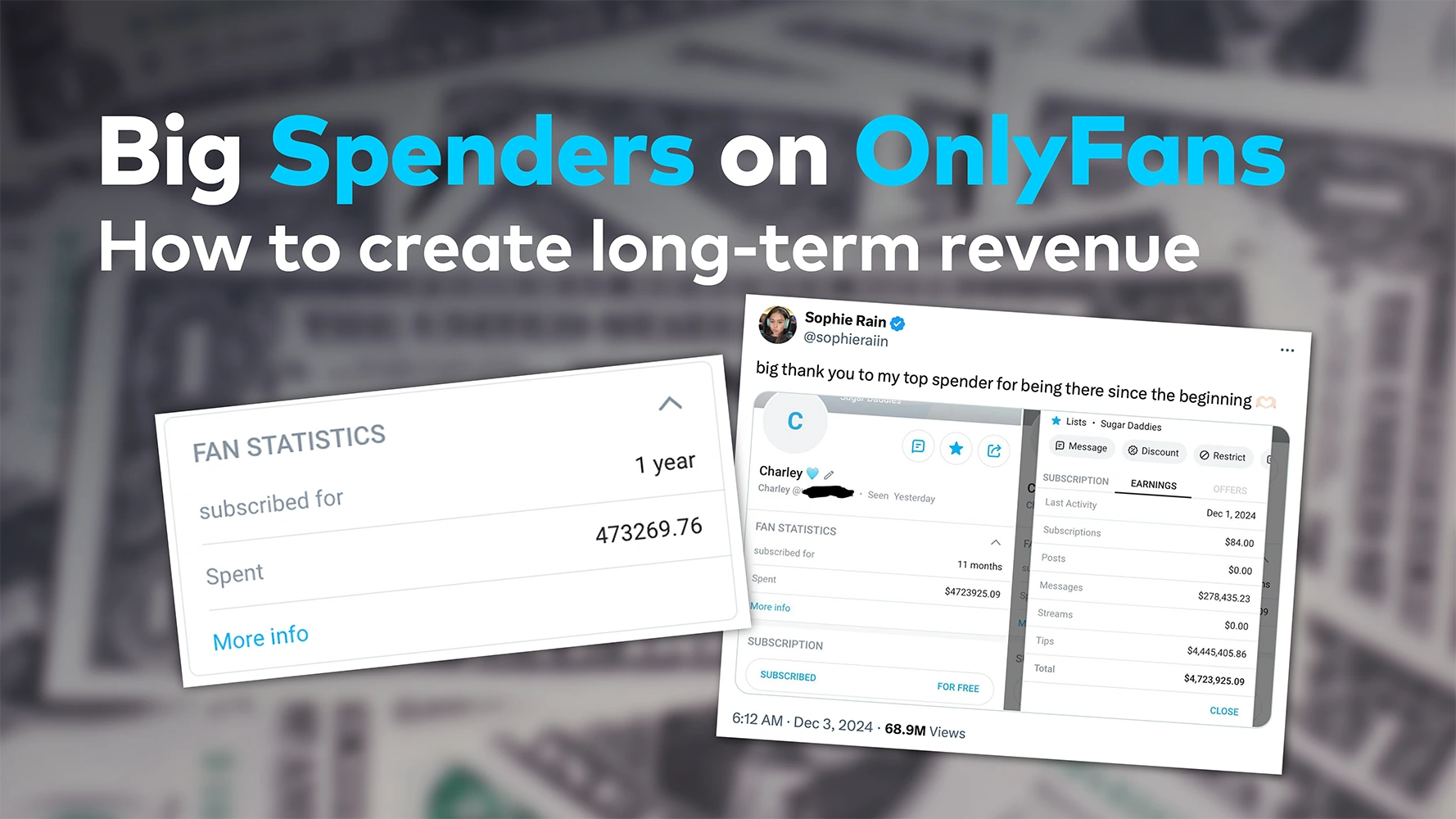
Getting a whale is the cheap part. Most accounts that land a high spender lose him within a couple of months, usually because nothing about his experience changed after he started spending. On the accounts we manage, roughly 80% of revenue comes through the DMs, and a disproportionate share of it comes from a small group of fans handled by a system, not by mood.
This is the second half of a pair. How to get more big spenders on OnlyFans covers finding whales: the $500 threshold, the 24-hour flagging window, and the cross-script escalation that builds them. This post is the playbook for what happens after. It shows how an OnlyFans chatting agency running 100+ creators treats high spenders day to day so they stay. If whales never show up on your account, read that post first. If they show up and then quietly disappear, keep reading.
Why Do High Spenders Need Their Own Playbook?
Because the behaviour that wins a whale is not the behaviour that keeps one. Winning him is a detection-and-escalation problem: spot the capacity early, walk him up the ladder. Keeping him is an operations problem: hundreds of small, consistent touches delivered by different chatters across shifts that must feel like one continuous relationship.
That's why "just treat your top fans well" fails as advice: goodwill doesn't survive a shift change. The only whale treatment that holds up over months is the one that's written down. It spells out who counts as a whale, what they get every day, who delivers it, and what gets logged at handover. Everything below is that written-down version. It's also why scaling an OnlyFans agency runs on written documents: whatever lives only in the founder's head stops holding once more creators come on.
How Do You Segment High-Spending Subscribers?
By total lifetime spend on the account, tracked in the tag layer. Nothing else is reliable enough to act on. Message volume lies (some whales barely talk), compliments lie, even single big unlocks lie. Cumulative spend doesn't. We run four tiers on every account:
- New sub. No spend yet. Gets the welcome flow and the first rungs of the value ladder. Standard queue.
- Buyer. First unlocks are in. Gets worked along the ladder with normal follow-ups. Standard queue.
- Regular. Meaningful cumulative spend, but under the whale line. Gets priority replies and the first custom-content feelers. This tier is the whale pipeline.
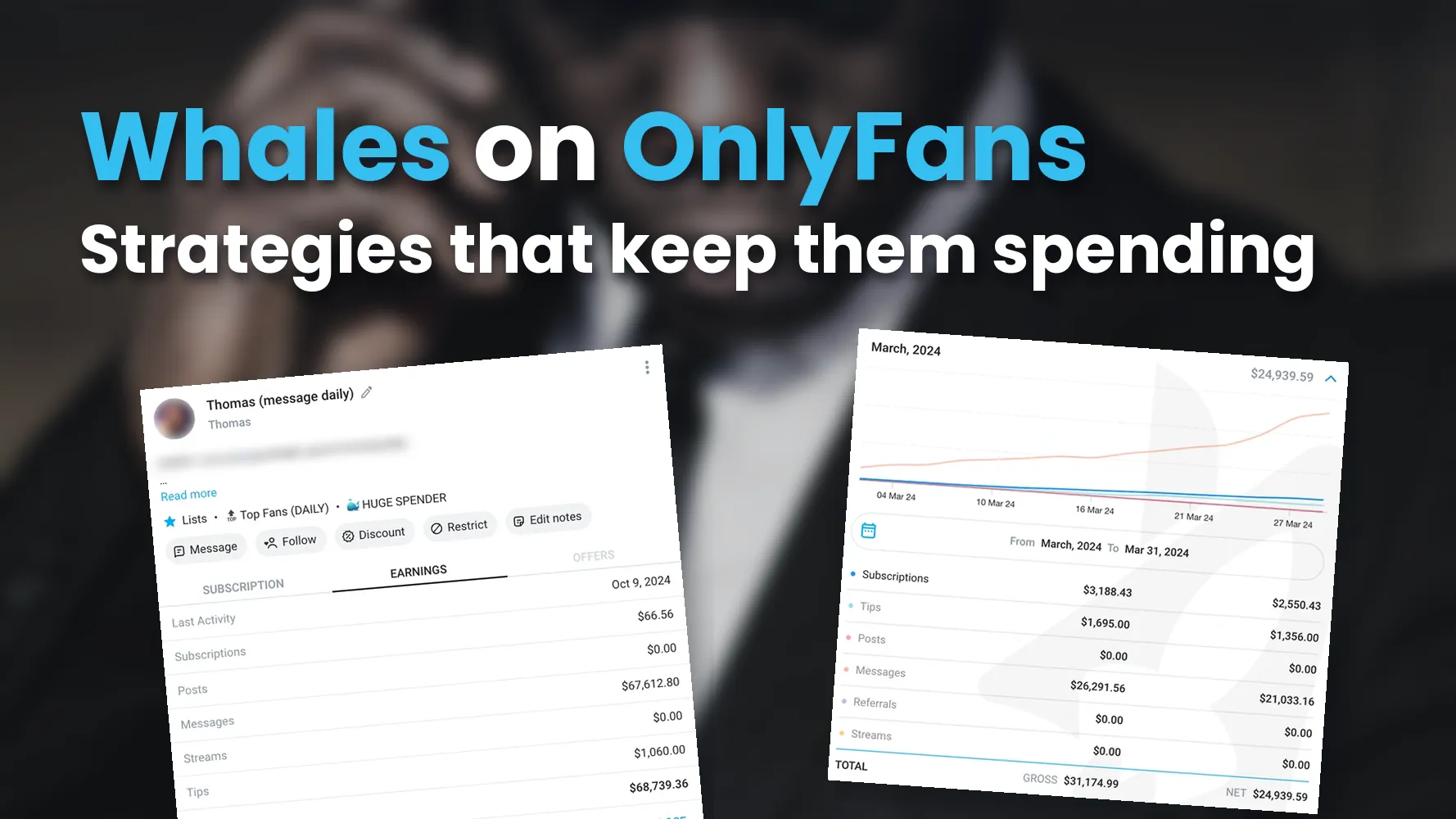
- Whale. $500+ total spend, the threshold we defined in the companion post. Front of the queue, daily 1:1 outreach, offers built around his history.
The tiers matter because each one changes three concrete things: how fast the fan gets answered, how often the account reaches out first, and what he gets offered. A tag that changes no behaviour is decoration. The fan sees none of it. He just experiences an account that values him more the more he invests, which is exactly the loop you want.
What Does the Daily Whale Routine Look Like on a Shift?
Every flagged whale gets three guaranteed touches: answered right after active conversations, contacted at least once every 24 hours, and logged at handover. The chatters on our team work this as a checklist, not as a suggestion, because a routine that depends on remembering is a routine that dies on the first busy day.
- Whales get answered right after active conversations. When the chatter opens the queue, a fan in the middle of a script run comes first, then whale conversations, ahead of new subs and the general backlog. A whale waiting behind forty small conversations is the most expensive queue mistake an account can make.
- At least one personal outreach every 24 hours, in his active window. A message written for him alone, referencing what he bought, what he said last night, what he's waiting on. Never a broadcast, never a recycled line. If his window falls in another shift, the handoff note says so and the next chatter owns it.
- Aftercare directly after every sale. The conversation doesn't end when the payment lands. The next messages are warm, unhurried, and sales-free. The fan needs to feel the purchase deepened the relationship rather than completed a transaction.
- A handoff entry per whale. What he bought, what was promised, what mood he was in, what to pick up next shift. Whale continuity lives or dies on this log.
Notice what's not in the routine: pressure. A whale who hears from the account daily buys on a fraction of those days. That's the design, not a failure of it. The daily touch keeps the relationship warm and earns the right to sell without selling in every message.
How Do You Raise Prices for a Fan Who Already Spends Heavily?
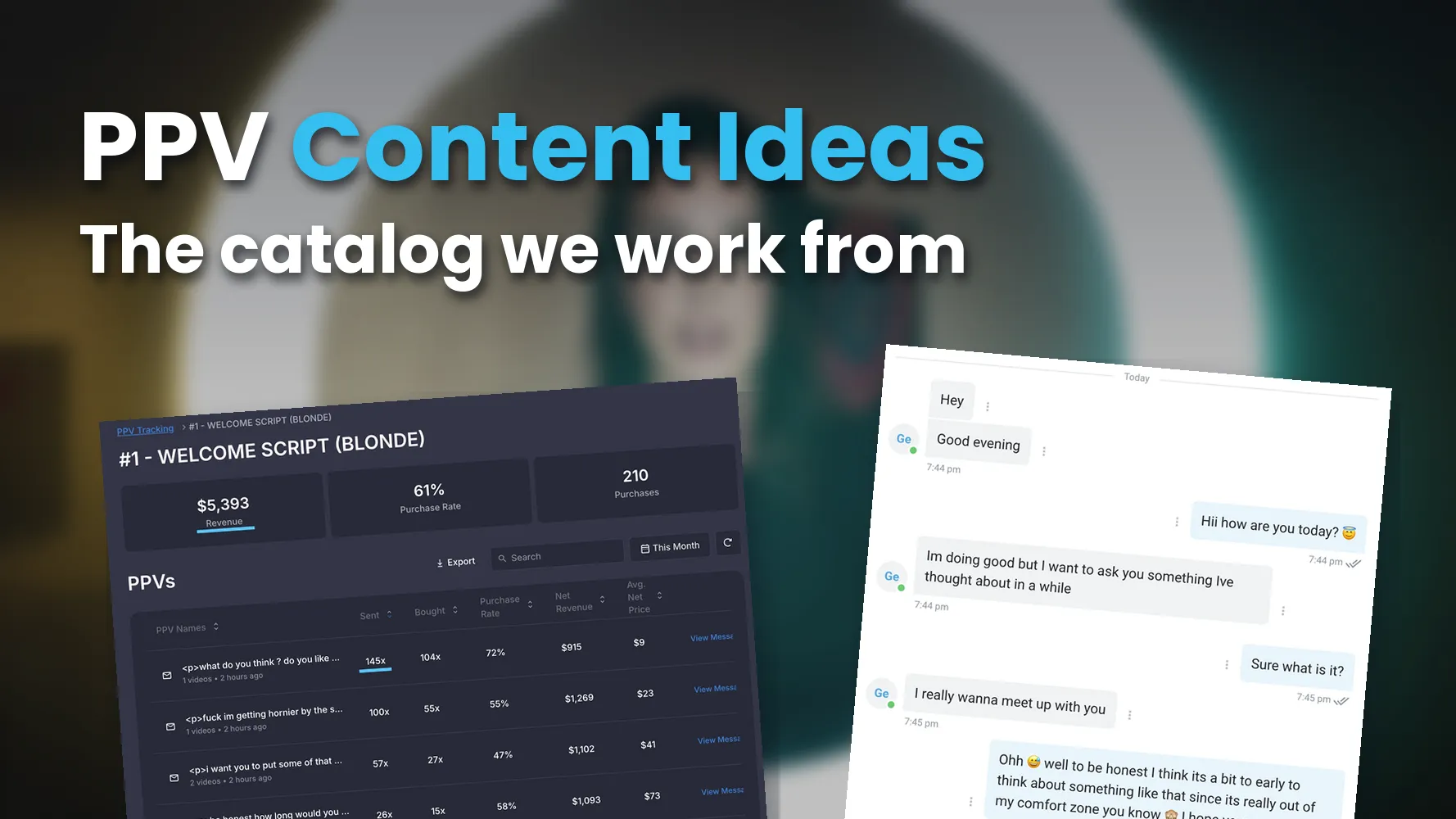
Ahead of him, never against him. The price grows with the relationship instead of being renegotiated inside it. On the accounts we manage, the standard PPV value ladder runs roughly $15 → $25 → $45 → $70 → $120. For most fans that ladder is the whole game. For a whale it's the runway. He clears the top rung faster than anyone else on the account, and what happens next decides whether his spend keeps climbing or flatlines.
What happens next, in our playbook, is that he graduates off the ladder entirely:
- Customs. Content made for him, priced on exclusivity rather than length. This is usually the first above-ladder purchase and the cleanest signal that the fan values the relationship over the content.
- One-of-one offers. Premium drops pitched to him alone, framed around his stated preferences and history with the account. The framing ("this made me think of you") is doing as much work as the content.
- First-access positioning. The whale sees new premium content before anyone else. It costs the operation nothing and reinforces the one thing he's actually paying for: status inside the relationship.
The rule holding it together: a whale's prices only move up. Once he's bought at $120, the offers made for him never drop back to $15, except as a deliberate warm-up inside a bigger arc. (The low-priced mass-message PPVs still reach him, because those go out to all fans.) Re-anchoring a top spender at bargain prices tells him his previous spending was foolish, and he'll act on that conclusion.
What Whale Retention Rate Is Realistic?
Around 80% of whales stay over six months. That's what we see across the accounts we manage when the full treatment above actually runs. The number is portfolio experience, not a market statistic, but it's stable enough that we manage against it: when an account's whale retention drops meaningfully below that line, we treat it as an operational failure and audit the routine, not the fans.
Measuring it is simple, and most accounts still never do it: take every fan who was tagged as a whale six months ago and check how many are still active and spending today. Reviewed monthly, that one number tells you more about your chat operation than most dashboards. It sits alongside the handful of numbers we cover in the chat metrics we actually watch.
Two caveats. Retention is an output. You push on the routine and the number follows. And 100% is the wrong target: budgets change, lives change, and some whales leave for reasons that genuinely have nothing to do with you. The real failure is losing one and not being able to say why.
Which Mistakes Drive High Spenders Away?
The expensive ones all share a root: treating the whale's spend as the relationship instead of the result of it. On the accounts that came to us, most whales who left did so because of one of these five patterns:
- Discounting. See above. The single most common unforced error, and it usually comes from panic during a slow week.
- Desperation selling. A quiet stretch turns every message into a pitch. Whales feel the switch from relationship to extraction instantly, and it confirms their worst suspicion about why the account is nice to them.
- Skipping aftercare. Sell, collect, vanish. Each cycle makes the next sale harder, until the whale concludes he's a wallet with a username.
- Persona breaks between shifts. The Tuesday chatter doesn't know what the Monday chatter promised, the tone shifts, a detail gets contradicted. High spenders are the fans paying closest attention. They catch inconsistencies first and forgive them least.
- Treating a plateau as a lost whale. A whale who slows down but keeps talking hasn't left. Hitting him with urgency offers at exactly that moment is how you convert a pause into an exit. Keep the treatment, drop the pressure, and let the next arc bring him back.
Should Whales Get All of Your Attention?
No. Whales get the priority slice, not the whole day. Pouring every chatter-hour into the top ten fans is the natural overcorrection once an account sees what a top spender is worth. It works for about a month, and then the pipeline is empty.
The math behind the balance: the average spend per paying fan on the accounts we manage sits around $30–40, and every whale was a $30 fan first. The regular tier is where next quarter's whales are built, one ladder rung and one custom feeler at a time. Starve it of attention and you cap whale revenue at the whales you already have, minus the ones who leave.
In practice, whale touches are scheduled first and non-negotiable, but bounded. The routine above takes minutes per whale per shift, not hours. The rest of the shift belongs to ladder work, welcome flows, and the regulars. The whale playbook sits on top of a healthy operation; it doesn't replace one.
FAQ
Should I ever give my top spenders a discount?
No. A discount re-anchors every price the whale has ever paid and turns a status relationship into a bargaining one. Reward top spenders with access and attention instead, like a first look at new content, a personal voice note, or priority treatment. Those cost less and strengthen the exact thing he's paying for.
How many chatters should handle one whale?
The whole team can, as long as the whale can't tell. One dedicated chatter per whale sounds romantic but breaks on the first day off. What actually keeps continuity is a strict voice guide plus a per-whale handoff log with what he bought, what was promised, and what to pick up next. Done right, five chatters read as one person.
What if a whale keeps chatting but stops buying?
Keep the treatment, drop the pressure. A talking whale is a retained whale. The spend usually returns with the next content arc or custom offer that genuinely fits him. If he goes fully silent instead, the dormant-whale reactivation schedule from our big-spenders post is the tool for that.
How do I know if my high-spender strategy is working?
Track two numbers every month. One is whale retention, meaning how many of the whales you had six months ago are still active and spending. Across our accounts, around 80% of whales stay over six months, so that's the healthy line. The other is the average spend trajectory of your regular tier. Retention tells you the playbook is holding; the regular tier tells you the pipeline is producing the next whales.
Put a system behind your top spenders
We run the tag layer, the daily whale routine, the upward pricing, and the retention reviews on every account we manage. Every shift, not just the motivated weeks. Let's look at how your highest-value fans are being handled right now.
Get a free account analysis