How to Get More Big Spenders on OnlyFans (And Keep Them)
Author
Lukas Böse · Founder of Boese VA
Lukas runs Boese VA’s 24/7 chatting team and helps creators and agencies grow on OnlyFans. Lukas on YouTube
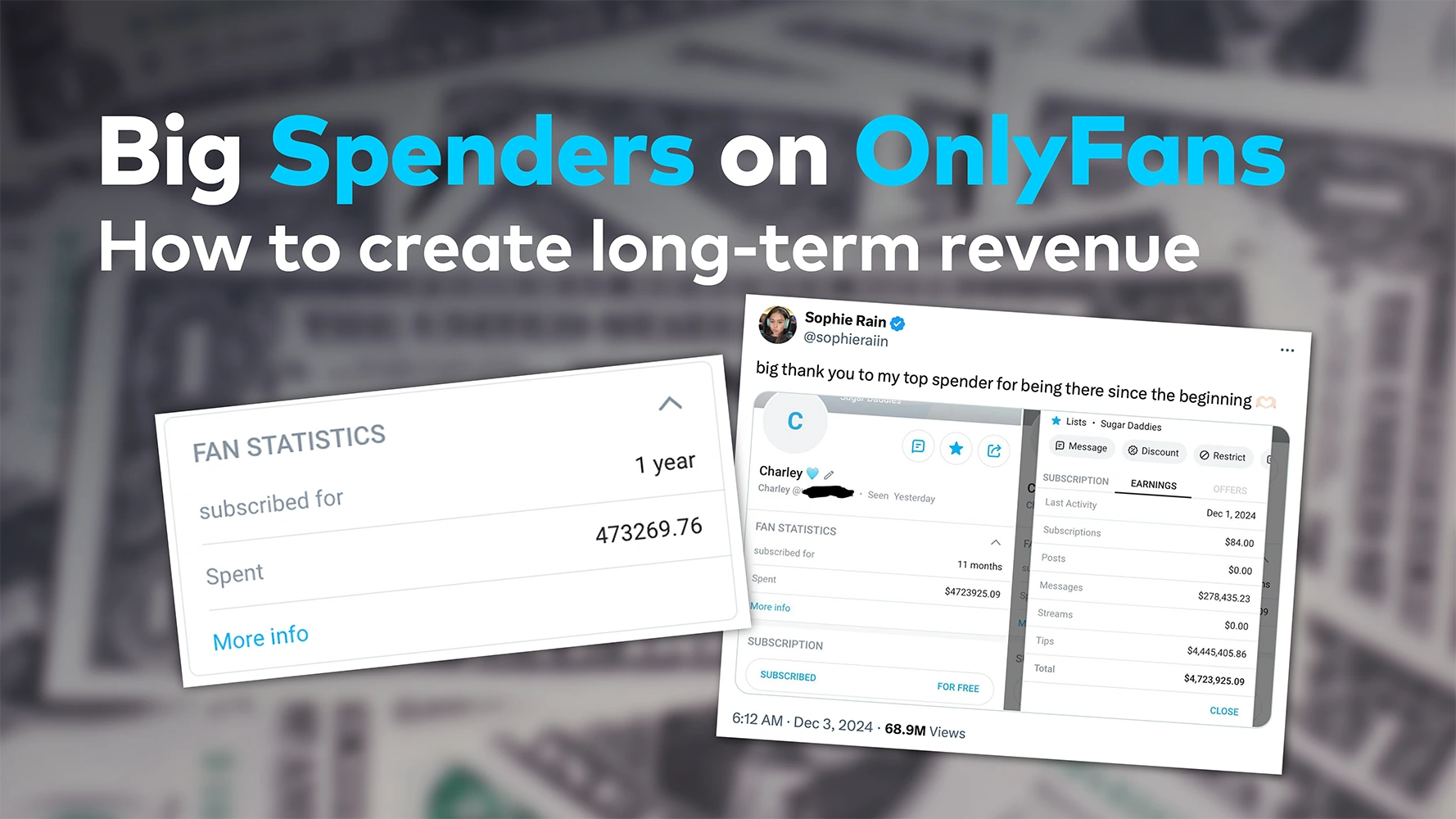
Big spenders aren't found — they're built. A fan who reaches $500 in total spend on the account rarely arrived at that level by accident; they were spotted early, treated differently from day one, and walked up a sequence of escalating offers until they were buying at a tier they didn't know existed when they subscribed. The accounts that consistently produce whales aren't lucky. They have a system for it.
This article covers the spending threshold we use to define a whale, how fast our chatters flag a potential one, the specific cross-script escalation tactic that converts mid-tier fans into top spenders, and the patterns that keep whales spending once they start.
What Counts as a Big Spender?
Any fan with $500+ in total spend on the account — that's the threshold we work with. "Whale" is loose industry slang, so we use a specific number the chatter team can act on without judgment calls. Below that bar a fan is mid-tier, above it the fan gets the whale treatment — faster queue position, dedicated outreach, custom-pitched offers, and an entirely different content trajectory.
The threshold is deliberately set above casual buyer levels. Many fans will spend $50–$200 over their lifetime without crossing into whale territory; that's healthy mid-tier behaviour and the value ladder is built for it. The $500 line is where a fan stops being a regular buyer and starts being someone whose retention is worth a meaningful operational investment.
How Do You Spot a Whale Within 24 Hours?
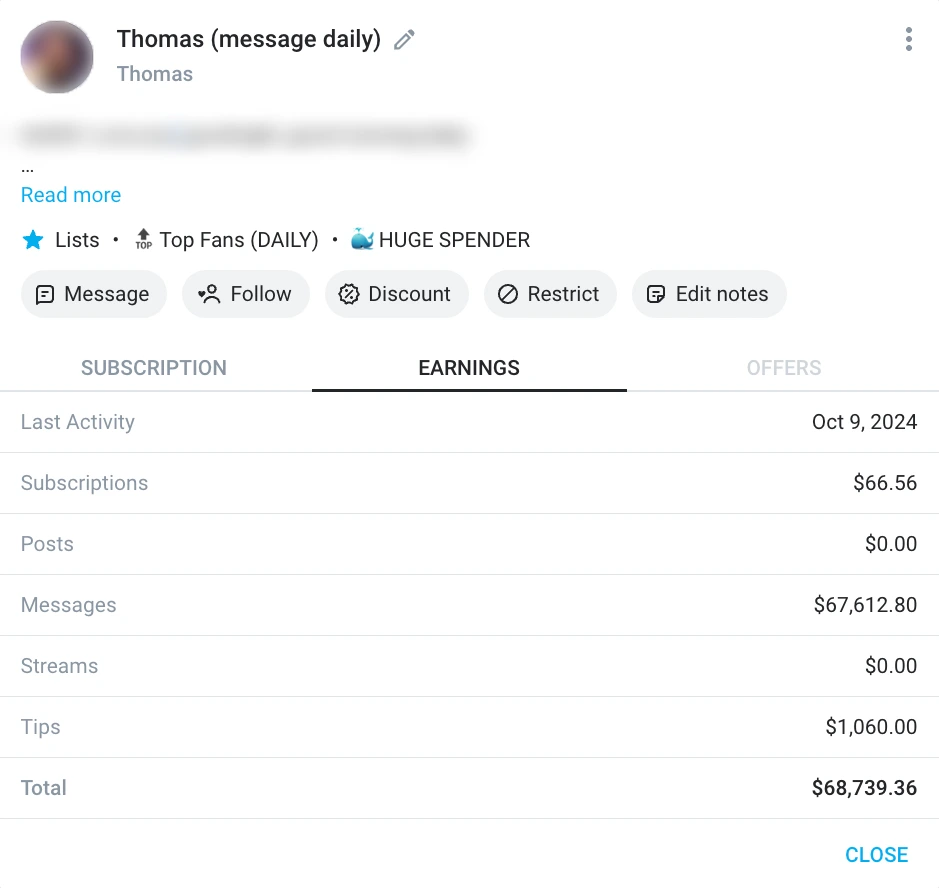
Watch total spend on the first script run — a fan who clears roughly $200 without hesitation gets flagged the same day. The trap most accounts fall into with whales is waiting too long to recognize one: by the time a fan's total spend has crossed $500, the chatter has already missed the highest-leverage window — the first unlock that signalled the fan's spending capacity.
We flag potential whales within 24 hours of crossing roughly $200 in total spend on their first script run. Single PPV unlocks don't tell you much — the team controls the price, so the unlock size reflects what was sent, not the fan's actual capacity. Total spend across the layered ladder of the first script is the real signal: a fan who clears the first three or four rungs without hesitation is showing capacity that the next script needs to be designed around immediately.
What "flagging" actually means operationally
- Tag updated. The fan moves from "new sub" or "active" to "potential whale" in the chatter system.
- Aftercare deepened. The post-unlock message gets extra warmth and a personal recall hook for the next conversation.
- Cross-script roadmap activated. The chatter starts mentally planning which subsequent script will move this fan up the GFE escalation.
- Whale outreach schedule begins. Manual outreach to this fan every day during their active hours, regardless of whether they've messaged.
None of this is visible to the fan. They just experience getting more attention. The operational shift happens entirely on our side of the screen.
How Do You Attract Big Spenders on OnlyFans?
You don't attract whales directly — you attract volume and build the conditions that let a whale reveal himself. Across the accounts we manage, the fans who end up at $500+ almost never look special on day one. What decides everything is what they meet in their first sessions:
- A fast first session. The fan's first chat sets his spending ceiling. In our experience, the biggest budgets have the least patience — if the first reply comes hours late, the future whale is the first to leave quietly.
- An escalation path that already exists. The cross-script tactic below only works because every account runs a tested script rotation before the whale shows up. Nobody spends $500 into an empty pipeline.
- A funnel treated like a shop window. Instagram brings roughly 60% of new subs across our accounts, so the bio link and the welcome flow are where a future top spender forms his first impression — long before a chatter ever talks to him.
Attraction, in practice, is readiness. The accounts that "get lucky" with whales are the ones where the machine was already running when he arrived.
How Do You Convert Mid-Tier Fans into Whales?
The mechanic works because it solves the structural problem of pricing higher: a fan who paid $120 for the top of one script's ladder doesn't pay $300 for the same kind of clip in the next script. They pay $300 for something that feels qualitatively new — a step deeper into the implied relationship. Each script's premise has to evolve, not just its content.
What changes across the escalation is the premise of each script — the relationship state the content implies, the framing the chatter uses inside the run, and the top rung of the value ladder. The specifics vary by creator and niche; what's universal is that the next script can't just be "the last one at a higher price." It has to feel qualitatively deeper for the fan to commit at the higher tier.
How Do You Keep a Whale Spending?
Daily contact, remembered specifics, and the dormant-whale love letter — three patterns that hold across the accounts we manage. Acquiring a whale is hard; keeping one is harder, because whales leave for the opposite reason most fans do — not because they're disengaged, but because they expect more attention than they got. The full keeping-them side — segmentation tiers, the per-shift whale routine, and how prices move once a fan spends heavily — lives in its own playbook: strategies for high-spending OnlyFans subscribers.
Daily contact during active hours
Every whale hears from the account at least once every 24 hours during their active window. Not necessarily a sales push — often just a check-in, a reference to their last conversation, or a thank-you. The signal is: you exist to this account.
Memory of their specifics
What they bought, what they didn't buy, what they explicitly asked for, what makes them laugh, what they shared about their life. All of this lives in the tagging layer and gets referenced in every conversation. Whales notice when they're remembered; they leave when they aren't.
The dormant-whale love letter
If a whale goes quiet, the love-letter schedule (every 2–3 weeks, hand-crafted, no PPV attached) kicks in. See the engagement tips post for the full mechanic. Most reactivations happen within the first few love letters.
What Is the Whale-Cohort Daily Sweep?
Every shift, the chatter manually reaches out to every fan currently flagged as a whale plus every fan who spent any money in the last seven days — individual messages referencing each fan's history, never a mass-DM. Operationally, this is where the proactive outreach covered in how chatting actually works lives day to day.
This single habit, applied consistently, is the largest contributor to month-over-month revenue stability we have. It's also the habit that solo creators almost never sustain, because there's always something else competing for their time. The sweep gets skipped on a busy day, then a second day, and within weeks the whale cohort has cooled.
Which Whale-Handling Mistakes Cost the Most?
- No differential treatment. Whales get the same generic experience as new subs. The most common failure pattern and the easiest to fix.
- Late flagging. Waiting weeks to notice a fan is spending heavily. The first 24 hours after the qualifying spend signal are when the relationship hardens; missing that window means lower lifetime value.
- No cross-script escalation. Selling the same kind of content at higher prices instead of evolving the premise. Whales notice and stop climbing.
- Skipping the daily sweep. "I'll catch up tomorrow" becomes a week. The whale cohort cools as soon as the schedule breaks.
- Forgetting their specifics. Asking a whale the same question twice, or sending a PPV they already bought. Both are unforced errors that shake the trust the relationship depends on.
FAQ
What counts as a "big spender" on OnlyFans?
In our operation, the threshold is $500+ in total spend on the account. Below that bar a fan is mid-tier; above it, they get whale treatment with differential queue position, daily outreach, and custom-pitched offers.
How fast should I move a fan into whale handling?
Within 24 hours of the qualifying signal — roughly $200 in total spend across the first script run, cleared without hesitation. A single PPV unlock on its own doesn't qualify a fan, because the team controls the price; total spend across the ladder is what triggers the operational shift. Waiting weeks loses the highest-leverage window.
How do I move a mid-tier fan up to whale spending?
Run them through consecutive scripts where each script's outfits, situations, and language feel progressively more like a relationship rather than a content drop. The price tier follows the intimacy escalation, not the other way around.
How often should whales hear from the account?
At least once every 24 hours during their active window. Not always a sales push — often just a check-in, a callback to a previous conversation, or a thank-you. The signal of consistent contact is what whales pay for.
What if a whale goes silent?
Move them onto the dormant-whale love-letter schedule: every 2–3 weeks, hand-crafted, personal, no PPV attached. The point is to remind them they exist to the creator. Most reactivations happen within the first few letters.
Build a whale pipeline, not whale luck
We run the flagging, the cross-script escalation, the daily sweep, and the love-letter schedule on every account we manage. Let's see how many whales your account already has hiding in the data.
Get a free account analysis