The OnlyFans Chat Metrics That Actually Matter (What We Watch Weekly)

Author
Lukas Böse · Founder of Boese VA
Lukas runs Boese VA’s 24/7 chatting team and helps creators and agencies grow on OnlyFans. Lukas on YouTube
Most "chat metrics" advice on OnlyFans is a long list of every number the platform exposes. That isn't useful. The chat operations that scale focus on a small set of metrics — three, usually — and ignore the rest until those three are healthy. The metrics aren't secret. The discipline of only watching them is what separates a working chat operation from one drowning in dashboards.
This article covers the three metrics we review weekly across the accounts we manage, the per-chatter productivity benchmark we hold the team to, and why the easiest of the three to calculate is the one almost nobody tracks.
Why Do Chat Metrics Matter More Than Total Revenue?
Because revenue only tells you what already happened. Total monthly revenue is what creators and agencies celebrate. It's also a lagging indicator that lumps together everything that's working with everything that's broken. By the time total revenue drops, the underlying mechanic that broke has been quietly degrading for weeks. The point of chat metrics is to see the breakdown earlier — when there's still time to fix it cheaply.
The three numbers we watch weekly are leading indicators of revenue, not measurements of it. They move before total revenue does. A team that watches them weekly catches operational drift before it costs a quarter; a team that only watches total revenue ends up troubleshooting symptoms.
Which Three Metrics Do We Watch Weekly?
$ per script start, PPV unlock rate, and top-10 fan revenue share. One tells us whether per-fan revenue is being produced, one whether the conversion mechanic is healthy, one whether whale care is in balance.
1. $ per script start
The single most diagnostic metric in our entire operation. It measures revenue per fan who entered a given script — total dollars produced by the script divided by the number of fans who started it. Our portfolio average sits at roughly $50 per script start. Scripts performing well above that get prioritized in rotation; scripts below it get rewritten or retired.
It is also the metric almost nobody chatting solo tracks, even though it is the easiest of the three to calculate from data you already have.
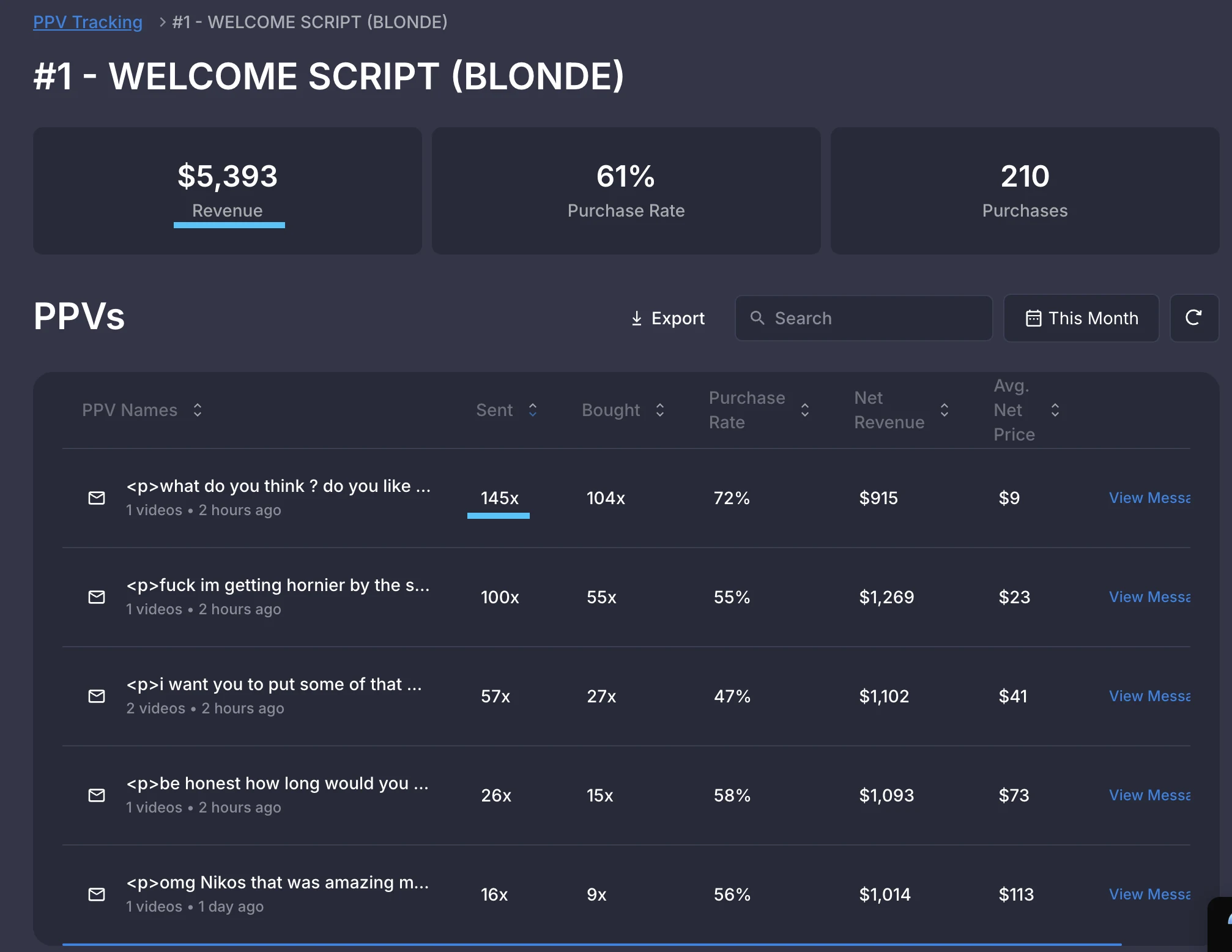
Operationally, the workflow built around this metric:
- Every script gets a name and tracking ID.
- Every send is attributed to a script.
- Weekly review pulls $/script start for every active script in rotation.
- Underperforming scripts get rewritten or dropped; outperforming ones get more of the cohort.
Without this attribution layer, every script's performance gets averaged into a single revenue number and the team has no signal about which mechanics are actually working.
2. PPV unlock rate — read separately for mass and personalised sends
The share of recipients who unlock the PPV after it's sent. This is the number most often quoted without saying which kind of send produced it, and the two bands are an order of magnitude apart. A personalised PPV inside an active chat sits at 40–80% across the accounts we manage; below 40% something is broken, usually the teaser, the segmentation, or the timing. A mass message to the whole list lands at 3–8%, or 8–15% when the send is staggered by segment instead of going out flat.
Both bands are worth watching, but never against each other. On either one, unlock rate is the first metric to drop when an account starts cooling, which is why we look at it every week.
3. Top-10 fan revenue share
The share of monthly revenue coming from the account's top 10 spenders. Healthy range in the accounts we run: 20–35%. Below 20% usually means the whale tier hasn't been built; above 50% means the account is dangerously concentrated and exposed if a single whale leaves. Top-10 share is the strongest signal of long-term sustainability we have.
How Much Should One Chatter Generate?
$50–$100 per hour of shift is the standard we hold active chatters to — the one per-person number we track beyond the account-level metrics. Chatters consistently below the floor get coaching or pulled off the floor; chatters consistently above it move to higher-value accounts (whale-heavy accounts, new-creator onboardings).
The $/hour metric is fair because it accounts for both effort and outcome. A chatter doing high volume on low-value fans can hit the benchmark; a chatter doing low volume on whales can also hit it. The path doesn't matter — the result does.
How Do You Diagnose a Problem From These Numbers?
You read them together, never one at a time. Which numbers moved and which stayed flat is what points at the mechanic that actually broke:
- PPV unlock rate drops, $/script start drops, top-10 share stable. Mid-tier conversion is breaking. Look at teaser quality, script staleness, or chatter pacing.
- Top-10 share climbs above 50%, total revenue flat. Whale dependence is growing; the mid-tier isn't producing. Look at welcome flows and value-ladder pacing on mid-tier fans.
- Top-10 share drops, total revenue drops. A whale just left. Check the dormant-whale love-letter schedule and figure out which fan stopped engaging.
- $/script start drops on a specific script only. That script has gone stale. Rewrite or retire.
- Chatter $/hour drops across the team. Process drift. Time for SOPs to be reviewed and re-trained.
None of these diagnoses are possible without the underlying weekly review. Without the data, the symptoms read as a vague slump and the response is usually wrong.
Which Metrics Are Worth Ignoring?
Subscriber count above all. After that: total messages sent, feed likes and views, and the chatting ratio.
Other metrics that look interesting but don't drive decisions:
- Total messages sent. Volume isn't quality. A chatter clearing 500 messages with no progress per message produces less revenue than one sending 200 intentional messages.
- Likes and post views. Public-feed engagement doesn't correlate with DM revenue.
- Time-of-day micro-tracking. Unless it changes your scheduled drops, knowing fans were active at 2:43 PM versus 3:17 PM doesn't help.
- Aggregate "chatting ratio." The ratio of chat revenue to sub revenue is a vanity metric on accounts that already know chat is dominant. Don't optimize for moving the ratio; optimize for moving the absolute chat revenue.
FAQ
What's the single most diagnostic chat metric?
$ per script start. It isolates the performance of a specific script run against the cohort that started it, which makes it impossible to lie to yourself about whether the underlying mechanic is working. Most accounts don't track it; the ones that do see operational drift weeks earlier than the ones that don't.
What's a healthy PPV unlock rate?
It depends entirely on which send you mean. A personalised PPV inside an active chat sits at 40–80% across the accounts we manage, and below 40% means something is broken in the teaser, the segmentation, or the timing. A mass message to the whole list is a different metric: 3–8% flat, 8–15% when it's staggered by segment. Judging a mass send against the personalised band is the most common way creators talk themselves into believing the chat has stopped working.
How much revenue should a chatter generate per hour?
Our benchmark for active chatters is $50–$100 per hour generated. The path doesn't matter — high volume on low-tier fans or low volume on whales both count. The result is what's measured.
How often should I review chat metrics?
Weekly for the three core metrics ($/script start, PPV unlock rate, top-10 share). Monthly for per-chatter productivity and longer-term trends. Daily review is almost always overkill and produces noise instead of signal.
A chat operation that gets measured every week
We run the weekly reviews, the per-script attribution, and the per-chatter benchmarks on every account under our management. Let's see what your metrics actually look like underneath the surface.
Get a free account analysis