When to Switch Your OnlyFans Agency (And How to Do It Without Losing Revenue)

Author
Lukas Böse · Founder of Boese VA
Lukas runs Boese VA’s 24/7 chatting team and helps creators and agencies grow on OnlyFans. Lukas on YouTube
Switching agencies is the decision creators agonize over most and execute the worst. The reasons to switch are usually obvious in hindsight, but the actual mechanics — protecting access, keeping revenue steady through the transition, and onboarding cleanly with the new team — are where the avoidable losses happen. A bad switch can cost months of revenue. A clean one, with the right things protected from day one, does not need a recovery quarter.
This article covers the signals that mean it's time to switch, how the actual revenue curve looks during a well-run transition, the single piece of access you must protect above everything else, and the red flags to watch for in whichever agency you're considering next.
When Is It Time to Switch Agencies?
When you read your own DMs and don't recognize the voice, when the agency won't hand over your fan data, when your top spenders get the same treatment as everyone else. Seven signals come up often enough in the onboarding calls we take to be worth naming individually. Any one of them on its own is worth a conversation with another agency; two or more is usually decisive.
Spammy or off-brand chatting
If you read your own DMs and find messages you'd never send — mass-DMs at the wrong moments, oversold teasers, generic replies, or content offered at prices you'd never set — the chatter team isn't aligned with your account. This usually correlates with weak voice guides and no QA layer.
You don't own your fan data
Some agencies hold fan tags, conversation history, and segment data hostage to make switching expensive. This is a structural red flag — and a reason to switch before the dependency deepens.
Cookie-cutter strategy
If the agency runs the exact same playbook for every creator regardless of niche, fan base, or content style, it's not strategy — it's templated work. Strong agencies adjust per account.
The agency neglects whales
If your top spenders are not getting differential treatment, the agency isn't doing the highest-leverage work an agency exists to do. See the big-spenders post for what whale care should look like.
No reporting you can check yourself
A monthly revenue figure is not reporting. If you can't see what each script produced, what each chatter produced, and how the numbers were derived, you're being asked to take performance on trust — and you have no way to tell a good month from a lucky one.
Nobody senior reads the actual chats
Ask who reviews real conversations, how often, and what happens when a chatter drifts off-voice. If the answer is that the chatters are experienced and don't need it, there is no QA layer, and quality on your account is whatever the least careful person on the rotation decides it is.
Gut feeling
It doesn't sound technical, but the founders we onboard most often describe a vague sense of "something feels off" months before they decided to switch. Trust this earlier. The cost of getting a second opinion is one free conversation; the cost of waiting another quarter is real revenue.
What Does a Clean Transition Look Like?
Flat through week one, climbing from week two. That's the whole shape — no dip to absorb, no rebuild quarter to survive.
What actually happens during a clean handoff:
- Before the switch. Voice guide written. Fan tags and history exported (or recreated by the new agency from your existing DMs). New chatter team briefed before the handover date.
- First week. Switch goes live. New chatters take over. Fans don't notice the change, because the voice and the send schedule carry over unbroken.
- After the first week. The new operation's improvements start landing — tighter SLA, proactive outreach to spenders, value-ladder enforcement, the love letter to inactive whales. Revenue trends up.
What Do You Have to Protect on Switch Day?
Your credentials, and nobody else can do it for you. Rotate everything the day the switch goes live and pull the old agency's access yourself.
The access checklist for the switchover day:
- Rotate the OnlyFans account password. Personally. Not through anyone.
- Rotate the linked email password and security questions. Email compromise is how account takeovers usually happen.
- Revoke prior CRM access. In Infloww/CreatorHero, remove the prior agency's users explicitly. Don't rely on them to "leave."
- Check 2FA. Make sure backup codes aren't sitting in the prior agency's hands.
- Audit social media accounts and traffic sources. If the agency had access to your Twitter/Instagram/Reddit promotion accounts, those need new passwords too.
How Do You Vet the New Agency?
By holding them to a higher standard than the agency you're leaving. Seven questions do most of the filtering, and two of them are disqualifying on their own.
The thing creators do least well during a switch is vet the new agency to a higher standard than the old one. The questions worth asking before signing:
- Will I get CRM access to read my own chats? If no, walk away.
- How is chatter access provisioned? Per-user CRM logins, not passwords. If the answer is "we use your password," walk away.
- What's the response-time SLA? Reputable agencies have a written standard. The "we reply fast" answer isn't enough.
- Do you have a voice guide template I'll fill out? If no, they don't train chatters in your voice.
- How is whale outreach handled? Daily, manual, per-fan referenced. Anything else is generic.
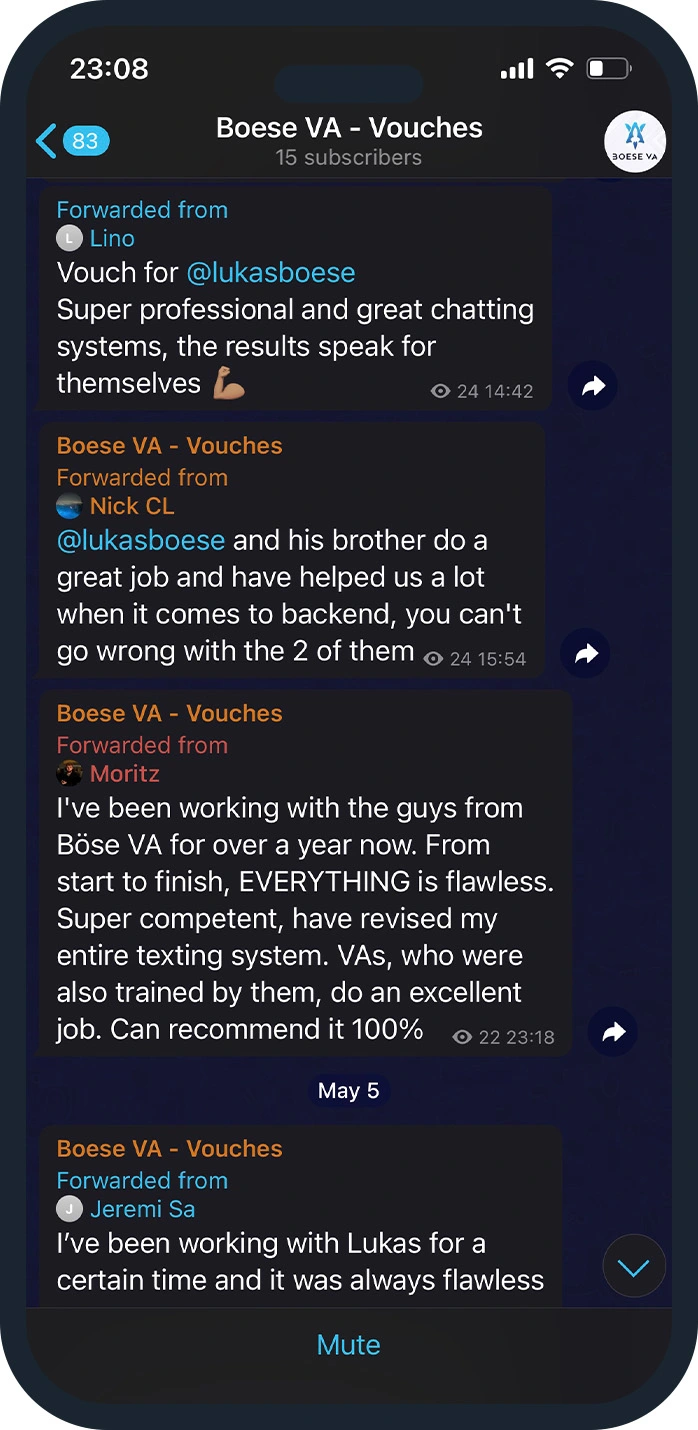
- Can I talk to existing creators you already manage? Reputable agencies offer references without you asking.
- What's the termination clause? Read it before signing. "Three months notice with no exit data" is a trap.
Which Switch Mistakes Cost the Most?
Skipping the password rotation is the expensive one — there's no undo. Switching under frustration, before you've vetted whoever comes next, is the common one.
- Switching before vetting the new agency. A switch under emotional pressure (frustration with the current agency) often lands somewhere just as bad. Vet first; switch second.
- Not rotating passwords on switch day. The single most expensive operational mistake during a transition. Always assume the prior agency retains everything they had access to.
- Skipping the voice-guide handoff. If the new agency takes over without a clear voice guide, fans notice within days and engagement drops.
- No exit clause negotiated up front. Same trap from a different angle. Whatever you can't exit cleanly, you'll be locked into the next time you need to switch again.
- Trusting the prior agency to "wind down access" gracefully. They might. Many don't. Plan for the worst case.
FAQ
Will my revenue drop during the switch?
That depends on how much of the fan history makes it across and how fast the new team gets the voice right — which is why nobody should quote you a curve for an account they haven't looked at. What we can say is that a switch done properly shouldn't need a recovery quarter. If an agency is forecasting months of dip as normal, that's their operational weakness, not the inherent cost of a switch.
How long does a transition actually take?
One to two weeks for full stabilization on the new operation. Beyond that, you should already be ahead of where you were on the prior agency, not still recovering from the move.
What's the most important thing to protect during the switch?
Account credentials and access control. Rotate your OnlyFans password, your email, and any 2FA on switch day. Revoke prior agency access explicitly in your CRM. Don't trust gradual handoffs.
How do I avoid losing fan history during the switch?
Either export your tagged fan data from the prior agency's CRM (request it in writing before the switch date) or budget time for the new agency to reconstruct it from your existing DMs. Reputable new agencies expect this and plan for it.
What if the prior agency tries to retaliate?
Most don't. Some do — fan-list scraping, posting your content elsewhere, public smears. The defenses against these are upfront contractual: written exit clause, IP ownership clearly with you, access locked down on day one. None of these can be retrofitted after the relationship breaks.
A switch that doesn't cost you a quarter
If your current agency isn't delivering, we run the kind of transition described above: voice guide written first, fan history moved before go-live, credentials rotated by you. Let's see what your account would look like under our operation.
Get a free account analysis