How to Actually Drive Engagement on OnlyFans (From a Chatting Agency)
Author
Lukas Böse · Founder of Boese VA
Lukas runs Boese VA’s 24/7 chatting team and helps creators and agencies grow on OnlyFans. Lukas on YouTube
"Engagement" on OnlyFans isn't likes or comments — it's the rate at which fans reply, open PPVs, and spend. The accounts that earn the most aren't the ones with the friendliest DMs; they're the ones where engagement and revenue move together because every interaction is part of an operational system. This guide is about what that system looks like.
We'll cover the engagement metrics that actually predict revenue, the schedule patterns we run on every account, a specific Boese-internal tactic for dormant high spenders, and the engagement mistakes that quietly cap income even when fans seem to love you.
Which Engagement Metrics Actually Predict Revenue?
Three, and none of them are the ones usually discussed. Comment volume, like counts and story views are vanity metrics. The three signals below are the ones we actually review on every account — two with hard bands, one with a direction.
Top-10 fan revenue share
On a healthy account, the top 10 spenders typically drive 20–35% of monthly revenue. Below 20%, the account hasn't built a whale base and is over-relying on volume. Above 50%, the account is dangerously concentrated and one whale leaving causes a noticeable revenue dip. The 20–35% band means there's a strong whale tier but the mid-tier is also producing.
Unlock rate on personalised PPVs
Of the fans who get a PPV inside a live conversation, what share unlock it? 40–80% is the healthy band across the accounts we manage; below 40% means something is broken, usually the teaser, the timing, or the segmentation. Judge mass messages on their own scale — a send to the whole list lands at 3–8%, or 8–15% when it's staggered by segment, and holding it against the personalised band tells you nothing. Unlock rate is a leading indicator either way: it drops before revenue does, so it's the first place to look when an account starts cooling.
Time-to-first-personal-message for new subscribers
How long after a fan subscribes does a personal (not automated) message land in their DM? On accounts that scale, this is measured in minutes during chat hours and hours overnight, not days. New subs are at peak interest in the first 24 hours; latency here costs revenue forever.
Why Does Knowing Your Audience Come First?
Because you can't be personal with people you have no record of.
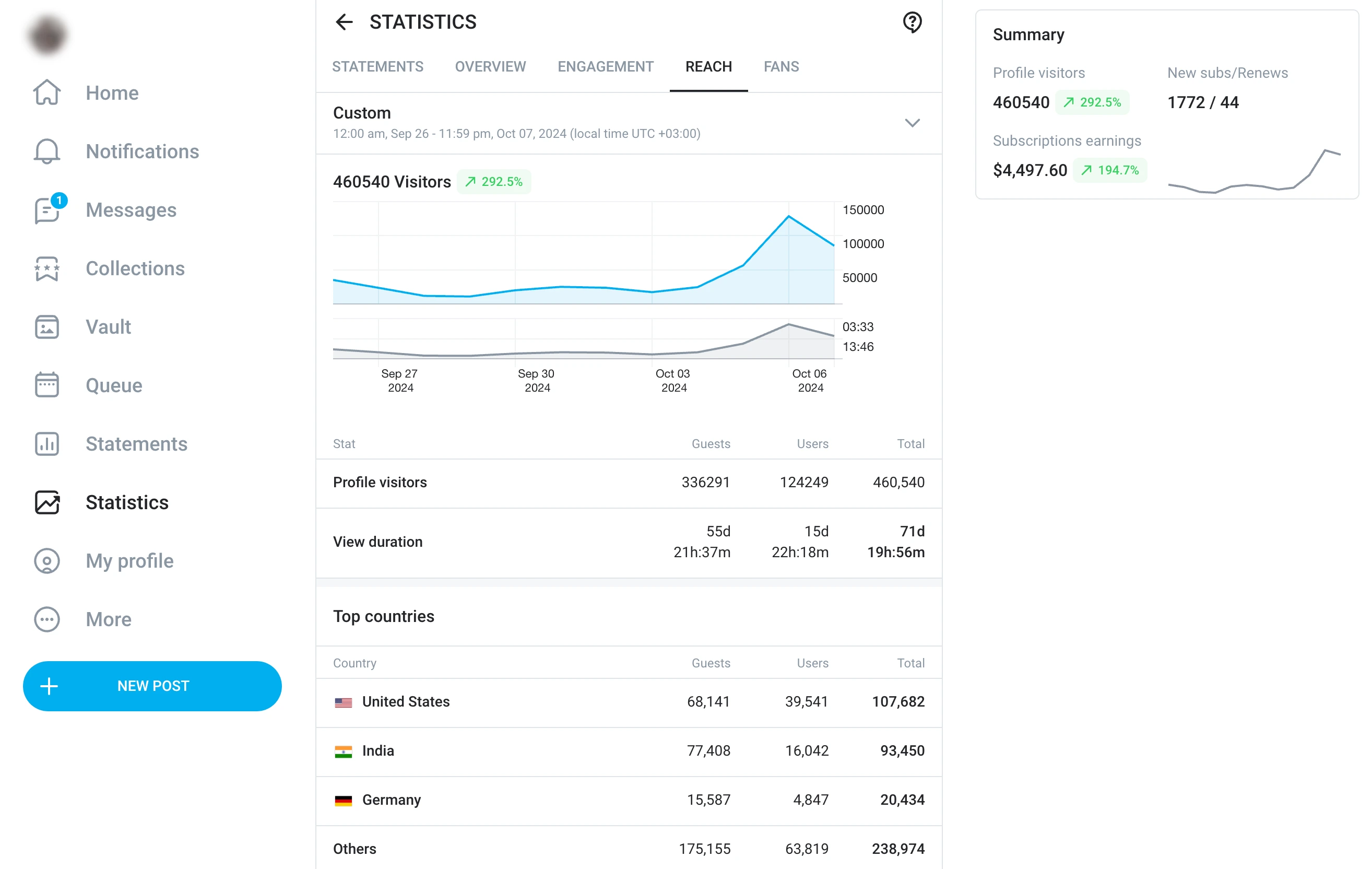
Strong engagement starts with knowing who you're actually engaging, and the accounts that scale invest far more in fan-level data than the average creator realizes.
What the platform gives you
OnlyFans Insights shows top countries, peak activity windows, and how each piece of content performed. It's coarse-grained but useful — particularly for tuning posting time to match where your audience actually lives. We pull it daily on every account we manage.
What you build on top
Native Insights tells you nothing about individual fans. The operational layer that matters lives in your tagging system — what each fan bought, when they last spent, what topics they engage with, what they've explicitly said no to. Without that layer, every conversation starts at zero, and fans feel it.
How Much Consistency Does Engagement Actually Need?
Enough that fans can predict you: a fixed weekly posting rhythm plus daily contact in their own time zone. Engagement is bought with reliability, not effort — fans get used to a rhythm, and when it breaks, they drift.
Feed posts on a fixed weekly schedule
Three to five feed posts per week, posted on the same days. This isn't about volume — it's about predictability. Fans return to check for the next post when they know one is coming.
Active conversations 24/7
Every fan on the active list should get at least one mass-message PPV per day during their active time zone window — not when it's convenient on our side, when it's prime time on theirs. Whales and last-7-day spenders get individual proactive outreach on top of that. See the proactive outreach mechanic in how chatting actually works.
How Do You Bring a Dormant Whale Back?
With a long personal message that sells nothing — internally we call it the love letter. The standard playbook for high-value fans focuses on the ones currently spending; the fan who used to be a top spender and went quiet gets written off almost everywhere. We don't write them off.
The reason it works is the exact opposite of why most reactivation campaigns fail. A mass DM reads like a sales attempt; a personally written letter referencing the fan's own history reads like being missed. Whales notice the difference.
Operationally, this requires the tagging layer to be alive — without records of what each whale spent on and talked about, you can't write the letter. That's another reason whale tracking gets so much weight in our setup.
How Do You Personalize at Scale Without Sounding Scripted?
By solving it at the system level instead of the message level — four habits carry almost all of it. Every engagement piece on OnlyFans repeats the same advice ("be personal"); almost none explain how to do that across hundreds of fans at once.
Reference specifics every fan can verify
Mention the day, the city, the weather, the time. "Just got home from the gym" works on anyone; it's specific without requiring per-fan knowledge.
Use names sparingly and accurately
Using a fan's name in every message reads as automated. Using it occasionally, in moments where it lands naturally, reads as attention. Generic pet names ("baby", "daddy") are fine but should not replace the fan's actual name when you have it.
Recall what each tier has bought
For active fans, every PPV pitch should be aware of what's already in their library. Sending a fan a clip you already sold them is a fast way to break trust.
Tier the warmth
A new sub gets a warm but contained welcome. A whale gets the love letter treatment. A cold sub gets a re-engagement nudge, not a sales push. Same chatter, different gear.
Which Engagement Mistakes Quietly Drop Revenue?
The most expensive engagement mistakes are the ones that don't look like mistakes. Fans seem happy, conversations seem healthy, and revenue stays flat. The most common patterns we fix on new accounts:
- Engaging only with buy-ready fans. See above. The fastest way to cap revenue while looking productive.
- One tone for every fan tier. Treating whales, mids, and cold subs the same. Whales need depth, cold subs need re-engagement, the two messages should not look alike.
- Reactive only. Replying when messaged but never initiating. The fan ends up in control of the rhythm, which means weeks can pass between meaningful contacts.
- Asking too many questions. Engagement isn't an interview. A chatter who only asks questions feels like a survey; a chatter who shares, observes, and leads feels like a person.
- Going dark after a sale. A fan unlocks a PPV and the conversation stops. The fan who just bought is the most likely to buy again — a thank-you message inside 24 hours converts the relationship into a repeat one.
FAQ
What's a realistic top-10 fan revenue share for a healthy account?
On accounts we manage, 20–35% of monthly revenue typically comes from the top 10 fans. Below 20% usually means the account is over-reliant on volume; above 50% means it's dangerously concentrated and a single churn will hurt.
What's a healthy PPV unlock rate?
On personalised PPVs inside an active chat, 40–80% across the accounts we manage; below 40% means something is broken, most often the teaser or the segmentation. A mass message to the whole list is a separate metric and a separate scale — 3–8% flat, 8–15% staggered by segment. Whichever one you're looking at, it falls before revenue does.
How often should I message each fan?
Active fans should hear from the account at least weekly. Whales should hear from the account every 1–3 days. Dormant high spenders get a love letter every 2–3 weeks. Cold subs get a re-engagement push monthly, not weekly.
Should I write to fans who haven't bought in months?
Yes — but selectively. Dormant high spenders are worth long, personal reactivation messages (the love letter). Dormant low spenders are worth a short, low-friction nudge. Don't write the same message to both.
How do I measure engagement if I'm not tracking metrics yet?
Start with two numbers: what share of monthly revenue comes from your top 10 fans, and what share of PPVs you send actually get opened. Even a manual count of these two each week tells you more than most analytics dashboards.
Find out where your engagement is leaking revenue
We'll pull your top-10 share, your unlock rate on personalised PPVs, and your dormant-whale list — and tell you exactly where the gaps are. No commitment.
Get a free account analysis