Best Converting OnlyFans Content Ideas (From the Accounts We Manage)
Author
Lukas Böse · Founder of Boese VA
Lukas runs Boese VA’s 24/7 chatting team and helps creators and agencies grow on OnlyFans. Lukas on YouTube
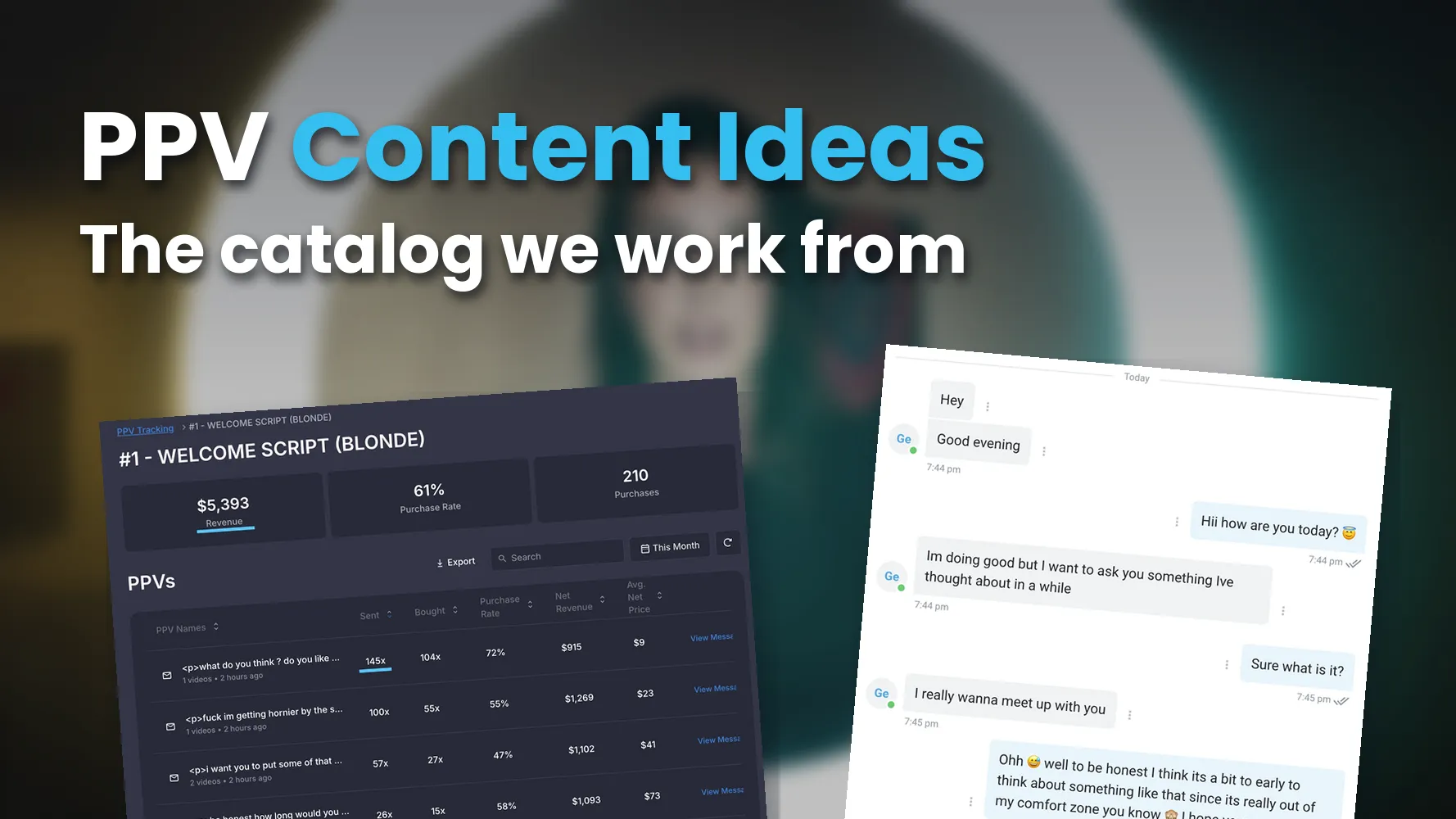
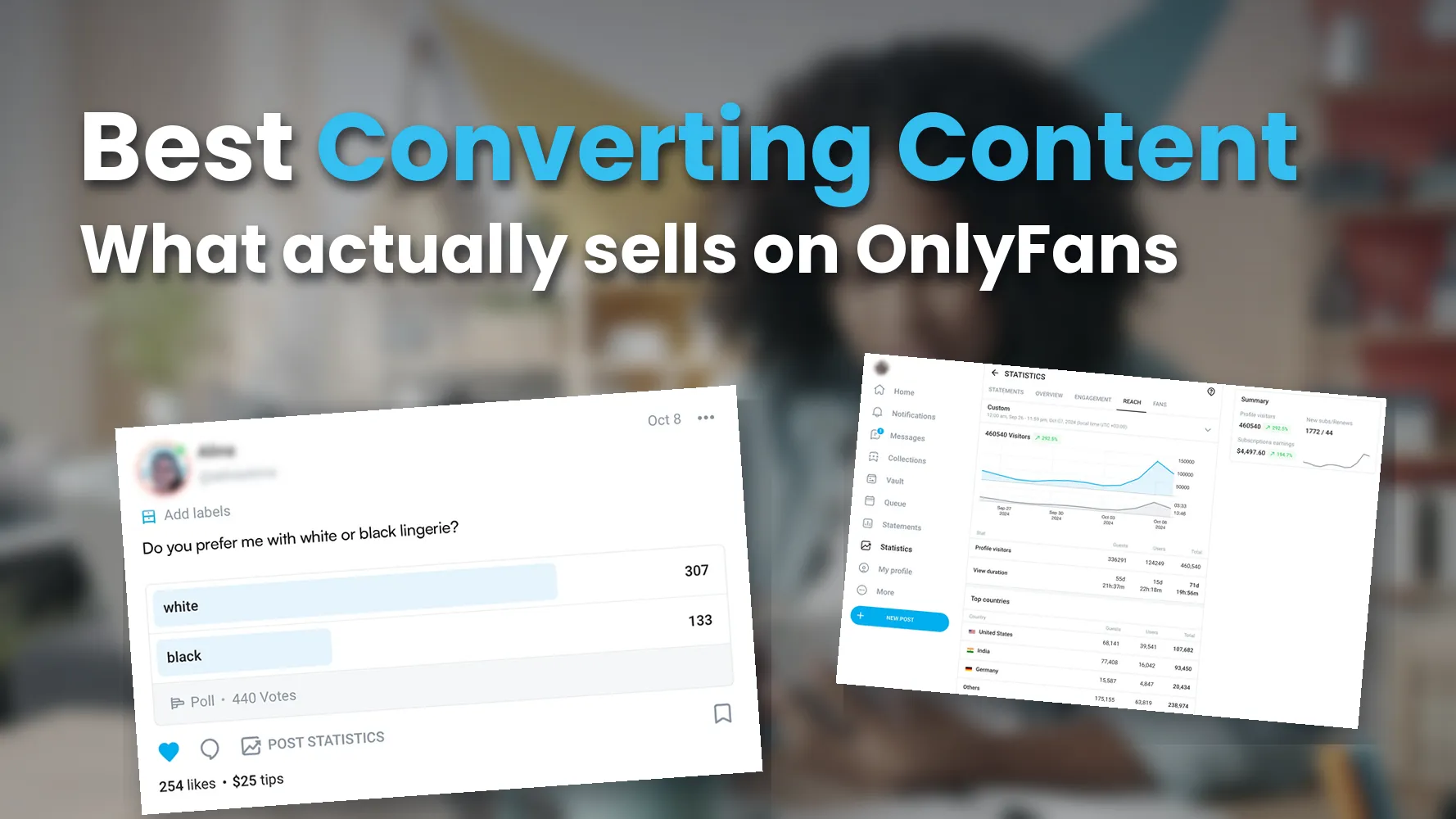
Ask ten people what the best converting OnlyFans content is and you'll get ten niches. That's the wrong axis. Across the accounts we manage, roughly 80% of revenue comes out of the DMs. Inside the DMs, what decides whether a piece sells is the content type. By type, we mean how the piece is framed, who it's sent to, and when.
This article breaks down the types that actually convert across our portfolio (personalized vs. broadcast, short vs. long, GFE formats, customs) and how to find out what converts on your account instead of guessing. It's written from inside an OnlyFans chatting agency that has run the DMs for 100+ creators since 2020, so the patterns below come from accounts we work every day, not from theory.
What Content Actually Converts Best on OnlyFans?
Personalized offers sent one-to-one in the DMs are the best converting content on OnlyFans, and it isn't close. Not a niche, not a production style, not a specific act. The same piece of content that dies on the feed or in a mass blast will sell at a multiple of the price when it lands inside a conversation where the fan feels it was meant for him.
Most creators ask the conversion question as "what should I film?" The more useful question is "how should what I already film reach the fan?" The feed is marketing: it attracts subscribers and keeps the account alive. The DMs are the store. On the accounts we manage, subscriptions and feed activity are a small slice of revenue; the rest is messages, PPV unlocks, and tips. So the type decisions that matter all happen at the DM level.
The four axes that actually decide conversion
- Personalized vs. broadcast. Was this written for one fan, or blasted to everyone?
- Positioned vs. cold. Does the send land mid-conversation, at a moment the chatter built, or out of nowhere?
- Sequenced vs. standalone. Is the piece part of a ladder that escalates in price and intensity, or a one-off?
- Standard vs. custom. Is it vault content, or something made for this specific fan?
Every "content idea" below is really a position on these four axes. That's also why niche lists rarely change anyone's numbers: they answer a different question.
Why Do Personalized Sends Beat Broadcast Sends?
Because the fan can tell whether a message was written for him, and he pays accordingly. From our portfolio experience, a mass PPV to the whole fan list unlocks at roughly 3–8% (8–15% when it goes out in price steps), while a personalized PPV in an active chat unlocks at roughly 40–80%. Same creator, often the exact same file. The only thing that changed is who received it and how it was framed.
Personalized doesn't require anything exotic. The chatter sends the PPV inside the conversation, and the caption references what that fan actually said or bought. "You loved the last one, this one goes further" reads completely differently to a fan who did buy the last one than to a cold sub seeing it as message one.
None of this makes mass sends useless. They're the top of the funnel and a fast way to surface which fans are awake and buying today. On our accounts, the mass send is where the sale starts. The fans who buy get a one-to-one follow-up while they're warm.
Which Content Types Sell Best in the DMs?
Four types carry most of the paid unlocks across the accounts we manage: laddered PPV sequences, GFE formats, customs, and simple low-production formats sold with context. Here's what each one is and where it earns.
1. Laddered PPV sequences
A sequence of PPVs inside one script or storyline, escalating in price and intensity. On our accounts, it typically follows a ladder like $15 → $25 → $45 → $70 → $120. Each unlock qualifies the fan for the next step, so the chatter is never guessing what a fan will pay: the last purchase already told them. This is the workhorse type on every account we run. If PPV mechanics are new to you, start with our full guide to creating and selling PPV content.
2. GFE formats
Girlfriend-experience content: a voice note saying the fan's name, a "just woke up" selfie, a short clip that answers something he said yesterday. Production cost is near zero, and it converts because it's proof of relationship. No vault file can fake that. On our accounts, GFE formats do double duty: they sell directly, and they set up the ladder sends that follow.
3. Customs
Content made for one specific fan, at a price no standard PPV reaches. Customs are a whale product: in our reporting, a whale is a fan past $500+ total spend, and those are the fans who request and pay for one-of-one content. Handled properly (remembered preferences, real follow-ups, no broken promises), around 80% of whales stay over six months on the accounts we manage. That's why customs compound instead of being one-off wins. We've written more on finding and keeping big spenders.
4. Simple formats sold with context
Selfie sets, short clips, worn items, ratings. These are the unglamorous formats that are fast to produce and sell every single week when they're delivered inside a conversation. We keep a whole list of these in easy things to sell on OnlyFans; the point here is that "easy" and "best converting" overlap far more than most creators expect, as long as the delivery is personal.
Do Longer Videos Convert Better Than Short Clips?
No. Context converts, runtime doesn't. A 45-second clip offered at the peak of a conversation the chatter built will outsell a 20-minute produced video sent cold, on price and on unlock rate. Fans don't buy minutes; they buy the moment the offer lands in.
Long content still has a home: the top of the ladder. By the fourth or fifth step of a sequence, the fan has already bought several times, the script has built a storyline, and a longer piece is the natural finale at the $70–$120 level. What doesn't work is treating length as the value itself and opening with the big file. The fan has no context for why it's worth more, so it reads as expensive instead of premium. Every sexting script on OnlyFans we run follows that build, from a cheap opener up to the climax piece on the top rung.
Why Doesn't More Production Mean More Conversion?
Because conversion happens in the conversation, not in the content library. When an account's revenue is flat, the reflex is almost always "film more." It's almost always wrong. Across the accounts we've taken over, the bottleneck is rarely the vault. It's that the existing vault is being sent cold, only as mass blasts, and without follow-up.
We've onboarded accounts with enormous libraries earning less than accounts with a vault full of items and a disciplined DM operation. A modest vault can be resold for months when every send gets new framing per fan: the same clip is a tease to a new sub, step three of a ladder to a returning buyer, and a callback ("this is the one I told you about") to a whale. That reframing is a selling skill, and it's exactly what professional OnlyFans chatters do on every shift.
More production also has a hidden cost: it eats the creator's time and energy that the account needs for the things only the creator can do (customs, voice notes, the GFE layer). If the DM operation isn't converting what already exists, new content just gives it more material to waste.
How Do You Find Out What Converts on Your Account?
You test one variable at a time and judge the result by revenue per script start instead of gut feel. Every account's audience mix is different, which means every "best converting content" list, including this one, is a set of starting hypotheses. The accounts that grow are the ones that turn those hypotheses into their own numbers. Here's the loop we run:
- Pick one variable. Content type, price point, or caption framing. Never all three at once, or the result tells you nothing.
- Run it consistently for a week. Same script across shifts and chatters, so the readout reflects the content, not one chatter's good night.
- Track unlock rate and revenue per script start. Across our portfolio, scripts average around $50 per script start. We hold new tests against that benchmark rather than against raw revenue, which volume can flatter.
- Read the result by segment. A script that flops on new subs can print on returning buyers. Averages across the whole fanbase hide exactly the signal you're looking for.
- Kill losers fast, rerun winners until they decay. Then log both. A few months of test logs is the most valuable asset an account has. It's the difference between knowing your fans and guessing at them.
FAQ
Does the niche matter at all for conversion?
It matters for who subscribes, much less for what they buy. Niche decides which fans land on the account; once they're inside, conversion is decided by delivery (personalization, positioning, sequencing). We see the same content types win across completely different niches in our portfolio, which is why this article is organized by type and not by niche.
What's a good PPV unlock rate?
From our portfolio experience, roughly 3–8% on a mass PPV to the whole fan list, 8–15% when that mass send goes out in price steps, and 40–80% on a personalized PPV in an active chat. Those are experience bands from the accounts we manage, not market statistics. The more useful comparison is always your own baseline.
Should a new account start with customs?
No. Customs convert because they're offered to fans whose spending history you already know. A new account doesn't have that history yet. Start with the ladder and GFE formats, let the spend data identify your first whales ($500+ total spend in our reporting), and introduce customs once there are specific fans to offer them to.
How often can you send PPVs before it burns the list?
There's no universal number. Buyers in an active ladder can receive multiple offers a day inside a script and love it; cold subs getting daily broad blasts tune out within weeks. On our accounts, mass PPVs go out to every fan twice a week, and an extra message goes to everyone who has bought a mass PPV before. The signal to watch is unlock-rate decay. When the rate slides send over send, you're sending too often or the framing has gone stale.
Stop guessing what your fans will buy
We run the testing, the follow-ups, and the ladder on every account we manage, every day. It's the same system described above. Let's look at what your account actually converts on.
Get a free account analysis